Instantly calculate the optimal route for any number of stops. Save time, fuel, and money with every run.
Traditional routing optimizes the drive. Atlas optimizes the destination.
Most routing tools just follow the order you give them. If you enter stops A → B → C → D, they simply find the fastest way to drive in that order.
The problem: If the order is wrong, the system just makes the wrong plan faster. It 'optimizes' the mistake leading to backtracking, wasted miles, and lost time.
Instead of following your stop order, Atlas looks at all stops at once and figures out the smartest sequence automatically. You just give it the stops. Atlas decides the right order - instantly and correctly.
The result: A perfectly efficient route with no manual rearranging, no nonsensical stops and no guesswork.
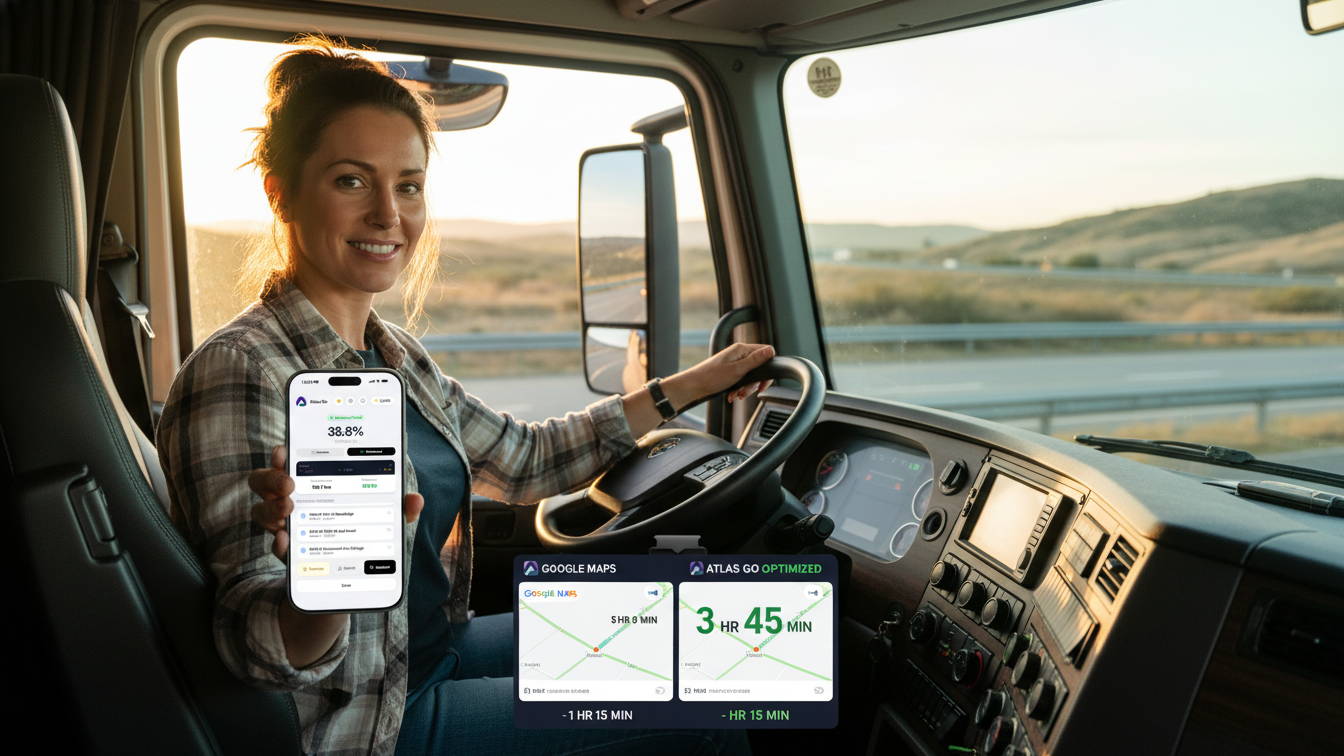
Understands the big picture - even with hundreds or thousands of stops.
Automatically groups nearby locations (no zig-zagging around the city).
Prioritizes urgent stops without breaking efficiency.
Delivers a route that is provably optimal, not “close enough.”
Other routing systems can’t explain why they choose a path. Atlas shows exactly why a route is chosen. Transparent. Auditable. All Physics.
View Explainer Presentation ›Side By Side Proof
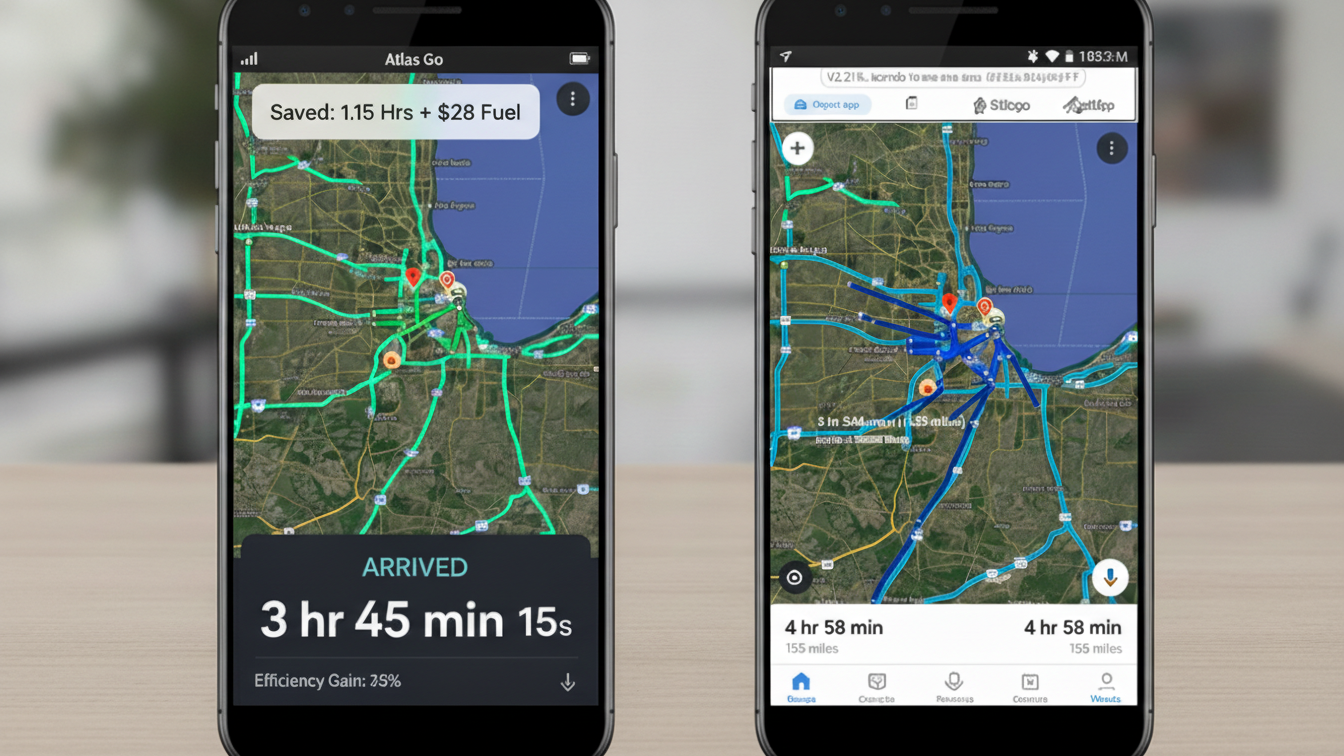
Atlas SDP doesn’t guess - it solves the route. Instead of trying millions of trial-and-error paths like traditional routing (including AI tools), Atlas calculates the best possible route from the start - instantly.
| Metric | Meaning | Impact |
|---|---|---|
| Efficiency Gain | % improvement over original route | More profit. |
| Distance Saved | Miles removed from the route | Lower fuel cost. |
| Fuel Savings | Real dollars saved based on MPG | Bottom line growth. |
Upload a manifest (.csv) or enter stops manually.
Add urgency to any stop (expiring load, VIP delivery, etc.).
Click Optimize Route.
A side-by-side comparison showcasing the gain achieved by the physics-based order over human-sequenced input.
| Metric | Human/Google Order | ATLAS Physics Order | Gain |
|---|---|---|---|
| Total Distance | 172 miles | 127 miles | 45 miles saved |
| Total Time | 3 hr 58 min | 3 hr 14 min | 44 minutes saved |
| Efficiency | 100% (Baseline) | 126% | 26% More Efficient |
The physics-based order saved 26% of the work without being told where the roads were.
Sign Up for 2026 PilotLegacy tools like Google, Waze, and ORION suffer from three main architectural flaws:
Unlike AI that "guesses," Atlas uses the Structural Dynamics Protocol. It evaluates every single stop together before deciding the first move. It plans the full journey end-to-end, not moment-to-moment. This means zero wasted miles and zero backtracking.
Yes. Drivers and dispatchers can test ATLAS SDP directly from their phones. You can run your current route in Google Maps and compare it instantly against the ATLAS physics-based route. In field tests, Atlas wins 99.9% of the time.
Yes. While legacy systems slow down or crash around 3,000 stops, ATLAS SDP has been tested on networks of 10,000+ stops, solving them in seconds with algebraic certainty.
We use a "zero-trust" design called Bank Vault Architecture. The computational core is an isolated enclave, and we are stateless-we solve your map and return the data without storing it.